A Story of Jealousy - SwathiKiranam
Tollywood Classic K Viswanath SwathiKiranam Mammootty
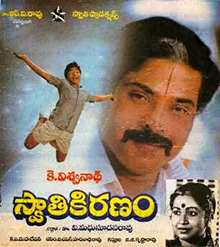
‘Swathi Kiranam’ - 1992
Anantha Rama Sharma, who appears emotionless within the temple premises, is constantly troubled by thoughts about Gangadharam. The villagers, seeing him outside the temple looking like a beggar, assume he is a child kidnapper and take him to the police station. There, Inspector Radhakrishna recognizes him. Anantha Rama Sharma’s entire past comes to mind for Pakshi Teertham Mamma, who earns a living by teaching music.
During a ceremonial honor (Gajarohanam) for Anantha Rama Sharma, who is praised as a ‘supreme embodiment of sacrifice,’ Gangadharam, upon seeing him, asks Mamma when he too would receive such an honor. She assures him, “If you become such a great scholar, it will happen to you as well.” When asked to learn music from her, Gangadharam instead roams around carefree, singing on his own.
A temple trustee requests Mamma to host Anantha Rama Sharma during the Brahmotsavam festival, and she agrees. In the presence of the Bharati Peetham heads, Anantha Rama Sharma sings magnificently. He is then instructed to compose music for lyrics written on Goddess Sharada. Despite his wife Sharada’s persuasion, Anantha Rama Sharma arrogantly rejects the ‘Padma Shri’ award.
When Anantha Rama Sharma visits Mamma’s house, Gangadharam sings in front of his wife. Unable to tolerate Anantha Rama Sharma singing the traditional “Mantrapushpam” in a different raga, Gangadharam sings it in yet another style before him. Feeling insulted, Anantha Rama Sharma scolds both Gangadharam and Mamma. As a result, Gangadharam faces humiliation everywhere. Unable to bear it, he goes with his parents and apologizes to Anantha Rama Sharma.
Anantha Rama Sharma undertakes the composition work assigned by the Bharati Peetham and composes a song. After hearing it, Gangadharam sings the same song in a different raga for academy scholarships. However, the selection board, headed by Anantha Rama Sharma, does not select him. This raises suspicions in Inspector Radhakrishna about Anantha Rama Sharma’s behavior.
Sharada promises to secretly support Gangadharam’s music education. Over three years, he learns music well and earns recognition in many places. On Guru Purnima, during a ceremony honoring Anantha Rama Sharma, Gangadharam performs. Unable to tolerate the sweetness of the boy’s voice, Anantha Rama Sharma grows increasingly jealous.
Though invited to preside over a felicitation ceremony for Gangadharam, Anantha Rama Sharma refuses. Even when a friend advises him that it is natural for the old to make way for the new and that his own singing pales before the boy’s brilliance, Anantha Rama Sharma, consumed by jealousy, does not listen.
When Gangadharam’s parents invite him to attend their son’s sacred thread ceremony (Upanayanam), Anantha Rama Sharma instead asks to host it at his own house. He offers Gangadharam shelter, claiming the boy will flourish more under his guidance. Inspector Radhakrishna suspects that even this gesture may be part of a scheme.
Gangadharam tries repeatedly to contribute to the Bharati Peetham’s compositions, but Anantha Rama Sharma rejects all his efforts. Finally, Gangadharam composes a piece and presents it to him, but it is again dismissed. Later, Anantha Rama Sharma performs the same composition at the Bharati Peetham. Realizing that Gangadharam has heard this, he is unable to bear the shame.
Returning home, he lashes out at Gangadharam, confessing that he cannot tolerate the boy’s talent and fame, and even says he could live with the guilt of killing him. Overcome with emotion, he suffers a heart attack. Sharada is distraught, fearing for her husband’s life. Seeing her suffering, Gangadharam becomes deeply distressed.
Before Anantha Rama Sharma returns home, Gangadharam leaves and ends his life. Sharada loses her sanity. With this, the past portion of the story ends.
In the passage of time, Anantha Rama Sharma, having renounced jealousy, is reborn like a child, learning music once again before his wife Sharada. Thus, the story of ‘Swathi Kiranam’ concludes.
----------------------
“Swati Kiranam” – a film by Swati Productions. The producer of this film is Dr. V. Madhusudhana Rao. In the spirit of “even a small measure of cow’s milk is enough,” as far as is known, this is the only film he produced! At the time, its financial failure might have been the reason. But it is remarkable that today this film is considered a classic.
The director of “Swati Kiranam” is K. Viswanath. He is as renowned as a director as he is as a screenwriter. From the time he joined Annapurna Studios under the leadership of Dukkipati Madhusudhana Rao as an assistant director to Adurthi Subba Rao, Viswanath used to immerse himself in numerous story discussions. It is well known that he had an indirect hand in the story development and screenplay writing of many films directed by Adurthi, such as “Chaduvukunna Ammayilu,” “Sudigundalu,” “Maroprapancham,” “Mooga Manasulu,” and “Thene Manasulu.” Even so, when he became a director himself with the Annapurna production “Atma Gowravam,” apart from selecting the story, he did not directly engage in writing it. Afterwards, for films like “Private Master,” “Kalisochina Adrushtam,” “Undamma Bottu Pedata,” and “Chelleli Kapuram,” he relied on stories by different writers and did not write them himself. His name appearing directly on screen as a story writer likely began with the 1971 film “Chinnanati Snehitulu.” After that, he made films like “Nindu Dampatulu,” “Kaalam Maarindi,” and “Amma Manasu” based on his own stories. With the appreciation these films received, he took a step further, beginning to write unique stories that no other director would dare to attempt—stories that reflected the grandeur of Indian music, literature, dance, and culture. This endeavor can be said to have begun with the 1976 film “Siri Siri Muvva.” In fact, it was a great beginning. For that film, Edida Nageswara Rao handled the production responsibilities.
Later, when Edida Nageswara Rao established his own production company, “Poornodaya Movie Creations,” Viswanath gained even greater creative freedom as both a writer and director. He was able to write film stories that most other producers would not agree to. Ignoring the commercial trend that prioritizes financial aspects above all, Edida Nageswara Rao supported Viswanath’s stories. Thus, the film “Shankarabharanam” was created. Fortunately, as Telugu audiences embraced the film wholeheartedly, it opened the possibility of changing the direction of Telugu cinema. If “Siri Siri Muvva” reflected the emotional pain of a mute young woman, “Shankarabharanam” became a mirror to the anguish of an aging musician unable to cope with changing musical tastes. Who could have imagined such characters—a heroine without dialogue and an elderly protagonist who lives only through music but cannot harmonize his personal family life—as leads on the Telugu screen? Yet, Viswanath dared to present them and succeeded. With even greater confidence, surpassing his own creative benchmarks, he presented diverse films like “Saptapadi,” “Subhalekha,” “Saagara Sangamam,” “Sirivennela,” and “Swarnakamalam” to Telugu audiences. All of these are music- and dance-oriented films.
Among these, “Shankarabharanam,” “Saagara Sangamam,” and “Swarnakamalam” deserve to be viewed from another perspective. While “Shankarabharanam” and “Saagara Sangamam” directly deal with the guru–disciple tradition in music and the continuous flow of musical heritage, “Swarnakamalam” portrays a lover who strives to bring out and refine the dormant dance talent within his beloved and present it to the world. In that sense, it too reflects a guru–disciple relationship. Until then, Viswanath had portrayed such relationships as deeply sacred. However, as a writer, in “Swati Kiranam,” he brings a completely different perspective to the screen. It is noteworthy that this film attempts to reveal the darker, hidden aspects that can exist even within such sacred guru–disciple bonds.
Whatever the case may be, there are also film stories that portray the unfortunate jealousies between guru and disciple, or between equals, and their consequences. Among such films, the first that must be mentioned is *Amadeus*. This 1984 Hollywood film was directed by Milos Forman. “Amadeus” is the middle part of the name of the famous musician Mozart. His full name is Wolfgang Amadeus Mozart. This is a story about the rivalry between him and the Italian composer Antonio Salieri. The film begins with Salieri expressing remorse, believing that it was his own jealousy toward Mozart that led him to murder him. While it is true that Mozart and Salieri were contemporaries of the 18th century, it is said that the level of jealousy and hatred leading to murder between them is far from historical reality. The film *Amadeus* was nominated for a total of 53 awards and won more than 40, including the Academy Award for Best Picture. However, it would be foolish to assume that K. Viswanath made the film *Swathi Kiranam* after watching or being inspired by *Amadeus*. Even before *Swathi Kiranam*, he had made films based on stories from the world of music, which can be considered the basis for this argument.
In fact, Kamal Haasan, who had immense respect for director Viswanath, once told him about *Amadeus*. He reportedly said, “It’s a film about professional jealousy between two world-renowned musicians. Isn’t that the style of your films? You should watch it once.” Viswanath said that although he liked the idea, he did not watch the film and instead developed the story in his own way. He felt that if both musicians were of the same age, the story wouldn’t have much variety. So he thought it would be better if one were older and the other a young child prodigy with extraordinary musical talent. He mentioned that he kept refining the story of *Swathi Kiranam* in this way.
As a storyteller, K. Viswanath presented many new dimensions in *Swathi Kiranam*, and as a director too, he showcased various approaches in the film. Casting a senior actor like Mammootty not as a typical hero but as a completely selfish, foolish, and jealousy-ridden character was a bold decision. Through the character of Anantha Rama Sharma, Viswanath portrayed arrogance in many scenes. For instance, when he is to be awarded the “Padma Shri,” he says, “If they offer it, we must accept it, right?”—a line that reflects his ego. The same person who says, “Respecting an artist is like respecting art and culture,” reacts with anger and even slaps Ananth when he learns that the honor is actually meant for his rival-like disciple. Such scenes symbolize the boundless jealousy within Anantha Rama Sharma.
Understanding characters thoroughly and portraying their traits consistently on screen is a fundamental quality of a good director, which becomes clear when watching Viswanath’s films. No character in his films behaves in a way that contradicts their core nature. For the main roles in this film, he chose Mammootty, Radhika, and Manjunath. None of them are native Telugu speakers; in fact, all three belong to different South Indian states. Mammootty is Malayali, Radhika is Tamil, and Manjunath is a Kannada child actor. Except for Radhika, the other two hardly knew Telugu. This meant that every shot had to be explained to them in English, along with the subtle emotions and meanings in the Telugu dialogues they had to deliver.
Instead of choosing actors fluent in Telugu to make his job easier, Viswanath took on extra effort, believing these actors were the right fit for the roles. Additionally, Bollywood actor Vinod Khanna wanted to remake this film in Hindi. He felt Jaya Bachchan would be suitable for Radhika’s role and arranged a special screening for her. After watching the film intently, Jaya Bachchan praised Viswanath, saying, “You have made this film wonderfully. Especially, your attention to small details is extraordinary.”
The dialogues for *Swathi Kiranam* were written by M.V.S. Haranatha Rao, a renowned playwright. Some of his stories and plays were adapted into films—for example, *Puli Champina Ledi Nethuru* became *Erramandaram*, *4 Varala Manishi* became *Sagatamanishi*, and *Aranya Rodanam* became *Ida Prapancham?*. His notable plays include *Raktabali*, *Jagannatha Rathachakralu*, *Yakshaganam*, *Kanyavarasulkam*, and *Ksheerasagara Mathanam*. With the recognition he gained from these works and the support of his college friend, director T. Krishna, he entered the film industry. He won Nandi Awards for Best Dialogue Writer for films like *Pratighatana*, *Ida Prapancham*, *Bharata Naari*, *Anna*, and *Ammayi Kaapuram*.
The dialogues he wrote for *Swathi Kiranam* are excellent. Some memorable lines include:
- “Today is Amavasya… the mind tends to be dull.” (00:10:25)
- “In India, are gods only on hills… don’t they exist on the ground?” (00:23:15)
- “Should I stand among all these dwarfs and receive the Padma Shri?” (00:34:30)
- “If the mind is peaceful, everything appears peaceful.” (00:36:35)
- “His scholarship is this much… as small as a mustard seed! His showmanship… that much… as vast as the sky!” (00:45:10)
- “Education without experience, however great, will not succeed.” (01:36:40)
- “What is a temple without a flagstaff? What is a house without an evening lamp?” (01:45:00)
- “A raga must have life, emotion must have vitality… the note must be alive… if all this were there, this composition would have been good.” (01:50:00)
The songs for the film *Swathi Kiranam* were written by Dr. C. Narayana Reddy, Sirivennela Seetharama Sastry, Vennelakanti, and Madugula Nagaphani Sharma. On screen, it is shown that the music was composed by K. V. Mahadevan. However, by the time this film began, Mahadevan had fallen ill. The entire responsibility of music direction fell on his assistant, Puhalendi. He composed the tunes for every song. Even so, after completing the film, he chose to have his guru K. V. Mahadevan’s name appear in the titles instead of his own—a truly noble act on Puhalendi’s part. As a disciple, it is an even greater distinction. Interestingly, the entire film *Swathi Kiranam* revolves around the guru-disciple relationship. Those familiar with Puhalendi in the industry do not consider him merely a disciple or assistant to Mahadevan; they regard him as Mahadevan’s inner self—another body visible externally. Such was the bond between them. His full name is T. K. Velappan Nair.
The songs in *Swathi Kiranam* were sung in the background by S. P. Balasubrahmanyam, Vani Jairam, Chitra, and Puhalendi. One could speak endlessly about any aspect of these songs—lyrics, music, situations, or picturization.
The song “Aanatiniyara Hara” appears in the Guru honoring scene of the film. It is picturized on Manjunath, while Mammootty, Radhika, Sakshi Ranga Rao, and others appear on screen. Manjunath’s performance in this song is outstanding. The song was written by Sirivennela Seetharama Sastry. Interestingly, he did not write it specifically for this film; he had originally written it in devotion to God. Later, realizing it suited this scene perfectly, he adapted it to fit a guru context, as he mentioned in an interview. Director K. Viswanath said the song was composed with the intent of resembling Tyagaraja’s Pancharatna Kritis. These are the five great compositions of Tyagaraja in Telugu: “Jagadanandakaaraka,” “Dudukugala Nanne,” “Sadhinchene O Manasa,” “Kanakana Ruchira,” and “Endaro Mahanubhavulu,” set in the ragas Nata, Gaula, Arabhi, Varali, and Sri respectively. Inspired by these, the team first prepared the musical framework and then had the lyrics written accordingly. The director noted that there is no other song in Telugu cinema written in this manner. Sirivennela remarked that such songs elevate film music to the level of poetry. For singing this song, Vani Jairam received the National Award for Best Female Singer in 1992.
Sirivennela wrote five songs for *Swathi Kiranam*. Among them, “Shivani Bhavani” was first sung by Vani Jairam and later by S. P. Balasubrahmanyam. The first version is picturized on Manjunath, and the second on Mammootty. The composition in the film is shown as an example of plagiarism committed by the character Anantha Rama Sharma. The descriptions of the goddess in the charanams—“Shringaram taranginchu Soundarya Lahari vaani, Shantam moorthibhavinchu Shivananda Lahari vani, Karuna jilugu sirinagavula Kanakadhara veevani”—are beautifully written.
Another Sirivennela song, “Telimanchu Karigindi Talupu Teeyana Prabhu,” was sung by Vani Jairam and picturized on Manjunath. Director Viswanath mentioned that he himself wrote the opening line, which Sirivennela then developed further. Another song by Sirivennela is “Jaaliga Jaabilamma,” sung by K. S. Chitra and Vani Jairam, picturized on Radhika and Manjunath. Another duet by Chitra and Vani Jairam, “Shruti Neevu Gati Neevu,” was written by Dr. C. Narayana Reddy and also picturized on them. For reasons unknown, Chitra and Vani Jairam never sang together again after this film.
C. Narayana Reddy wrote three songs for *Swathi Kiranam*. One of them is “Sangeeta Sahitya Samalankrute,” sung by S. P. Balasubrahmanyam and Chitra, featuring Mammootty and Radhika. In this song, we also get a glimpse of Swami Sri Sri Sri Ganapathi Sachchidananda. Another song by him is “Pranathi Pranathi Pranathi,” a unique composition offering deep salutations to the creator and creation.
Vennelakanti wrote only one song in the film, “Kondakonallo,” sung by Vani Jairam and picturized on Manjunath. The song is filled with simple, childlike words such as “garden, fort, stream, water, tree,” etc.
Madugula Nagaphani Sharma wrote the only “Jaajara” song in the film: “Jaajara Jaajara Jaajara… Jamuraathiri Jaajara.” The line “There is darkness in the bear’s cave… and light within that darkness” symbolizes the enlightenment that enters Gangadhar’s life. Interestingly, the lyricist himself appears on screen performing the song.
Kasturi worked as the Director of Photography for the film. Sheshu and K. V. Satyanarayana served as choreographers, though the finer movements in the songs were designed by Viswanath himself. Arun Godgaonkar was the art director.
*Swathi Kiranam* was screened at the 24th Indian International Film Festival held from January 10 to 20, 1993. It was also shown at the Asia Pacific Film Festival and the Moscow Film Festival, earning widespread acclaim. The film won the Nandi Award for Best Family Film in 1992.
Interestingly, although the film depicts a scene that dismisses the Padma Shri award, in the very same year of its release, director K. Viswanath received the Padma Shri from the Government of India. In that same year, he was also honored with the Raghupathi Venkaiah Award by the state government for his distinguished contribution to cinema.
Voice Over 3:
Mammootty played the role of Anantha Rama Sharma in *Swathi Kiranam*. Even though he knew the role was not the central one and had negative shades, he accepted it—a commendable decision. Viswanath mentioned that he never considered anyone else for the role. Despite Mammootty being a Kerala Muslim, Viswanath felt he was perfect for the role and imagined that with Vaishnavite markings on his forehead, he would look entirely like a Vaishnavite. When Viswanath narrated the story in his own simple style, Mammootty agreed to do the film upon hearing the climax. Initially, the director wanted S. P. Balasubrahmanyam to dub for the character, but Mammootty insisted on dubbing himself, suggesting they could reconsider if it didn’t work. His dubbing was ultimately approved. All the dialogues of Anantha Rama Sharma in the film are in Mammootty’s own voice. This was his first direct Telugu film. After this, he acted in films like *Suryaputrulu*, *Railway Coolie*, and *Yatra*.
Radhika played Sharada, the wife of Anantha Rama Sharma. Her character is deeply tragic—unable to confront her husband when he strays, and unable to express her maternal affection toward Gangadhar despite feeling it intensely. It is one of her finest performances.
Manjunath played Gangadhar. He gained nationwide fame as a child actor through the television series *Malgudi Days*. Starting from the age of three, he acted in about 68 films until his early teens, including Kannada films like *Banker Margayya*, *Swami*, *Tabarana Kathe*, *Bangarada Baduku*, *Ranaranga*, and *Ranadheera*. At a time when he had decided to stop acting as a child artist, he received the offer for *Swathi Kiranam*. Upon learning it was a Viswanath film, he accepted it without even knowing the story. After this film, he retired from acting.
Achyuth played Inspector Radhakrishna. He debuted with the film *Taj Mahal* and earned a reputation as a friendly actor. He later appeared in films like *Thammudu*, *Tholi Prema*, *Gokulamlo Seetha*, and *Narasimha Naidu*, but passed away at a young age due to a heart attack. Other cast members include Sakshi Ranga Rao as Anantha Rama Sharma’s friend, Ananth, Dharmavarapu Subrahmanyam as Gangadhar’s father, Mishro as the school teacher, K. K. Sharma as writer Sharma, Jit Mohan Mitra as a representative of an acting association, and Master Sastri as Gangadhar’s friend.
Dubbing Janaki played Gangadhar’s mother Seethamma, and Gayatri played the character with a speech defect. Swami Sri Sri Sri Ganapathi Sachchidananda appears as the head of Bharati Peetham, blessing devotees.
Special Notes:
*Swathi Kiranam*
Release: January 1, 1992
Length: 4,578.61 meters; 16 reels
Dialogues: M. V. S. Haranatha Rao
Music: K. V. Mahadevan
Producer: Dr. V. Madhusudana Rao
Story & Direction: K. Viswanath